Staying Calm in the AI Storm
AI is not the real threat to UX. The bigger risk is mistaking speed for intent and letting product experiences slide into an efficient, average sameness that fits no one.
TL;DR
The danger is not AI itself. It is what teams skip when AI makes flashy output easy. UX stays valuable by holding onto judgment, designing against the average, and shaping systems for humans and robots without surrendering clarity, taste, or intent.

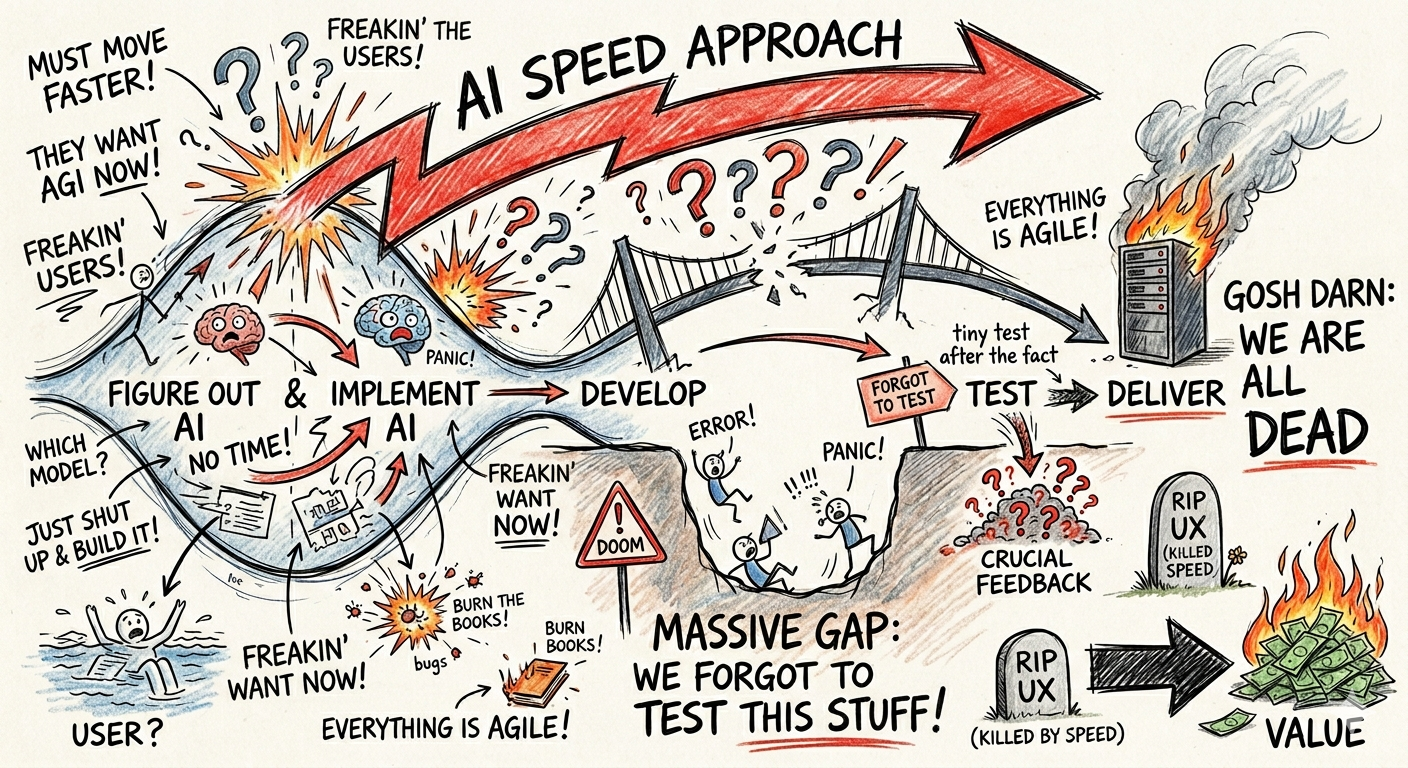
Yeah, AI generated. I’m fully aware I’m not an illustrator. We need illustrators.
Staying Calm in the AI Storm
How UX avoids a Neo-Brutalism Tech Depression
I’ve been calling it for a while now.
If we do not get this right, we are heading straight into a Neo-Brutalism Tech Depression.
A world where everything looks the same, acts the same, and feels the same. Grey. Grid. Efficient. Soulless. Optimized to death and somehow worse for it.
This is not really a fear of AI. That is the funny part.
I was chatting with a few UX friends recently and we kept circling around the same anxieties, the same opportunities, the same low-grade professional irritation. None of us were clutching pearls about AI taking over. If anything, the energy was excitement. There are so many possibilities here. The efficiencies are real. The speed is real. The ability to think, make, test, and explore faster has absolutely changed the game.
The frustration is not AI. The frustration is what people are willing to skip because AI made it easy to make something flashy fast.
We are moving a mile a minute with these tools, but as I have said before, designers are not developers and developers are not designers. Vibe coding is fun. It is addictive. It is accessible. It is also creating a very real temptation to confuse speed with clarity and output with intent.
That is where the storm is.
The prototype that said absolutely nothing
A friend told me a story recently that summed the whole thing up better than any panel discussion ever could.
Her VP spent a day putting together a flashy prototype for a new UI. He was thrilled with himself. His peers congratulated him. His direct reports patted him on the back. It looked impressive. It moved. It shimmered with possibility. Then he handed it over to his UX leader for review.
She stared at it.
Clicked through it. Tried to understand it. Tried sincerely to get on board with the whole brown-bandwagon future he had assembled.
And then finally said, “I do not know what you want users to do.”
The language was unclear. There was no CTA. The established patterns were gone. The colors, type, and branding had all drifted into some random alternate universe. It ignored what they already knew about their customers.
So she asked the only question that mattered.
What are you trying to solve with this?
That is the moment we are in.
Not whether the prototype is shiny. Not whether the VP had fun making it. Not whether everyone clapped because it looked modern.
What problem is this solving? For whom? Why this way? Based on what?
That is still our job.
The real fork in the road
We are at a weird little impasse.
Do we jump aboard the wagon and congratulate every vibe-coded solution to an undefined problem just to stay in the conversation? That is not a fake choice. For a lot of people, that is a defensive strategy. Keep the peace. Protect your role. Do not be the annoying person holding the line while everyone else is shipping glitter.
Or do we reassert what our discipline actually is?
Do we lean into the fact that our value was never really Figma and it was never really the tool? Do we go on offense and make the strategic play, even if it feels a little uncomfortable in the short term?
Because if we do not, we will keep sliding into that Neo-Brutalism Tech Depression. A product landscape where everything merges to center, looks similar, behaves similarly, and becomes aggressively average.
That is what AI is very, very good at. Efficiency and average.
The problem is no one is average.
The chair that fit no one
In the 1950s, the U.S. Air Force tried to design the perfect pilot’s chair. They gathered measurements from hundreds of pilots. Tallest, shortest, widest, narrowest, largest feet, smallest chests, every dimension they could measure. Then they averaged it all together and designed the ideal seat.
It fit no one.

So they changed the approach. They stopped designing for the average and designed something adjustable instead.
That is where we are with AI.
AI is spectacular at patterns. It is excellent at averaging behavior, predicting common paths, and pushing things toward optimization. Left alone, it will happily build the perfect chair that fits no one.
Without good UX, without creativity, without people from different backgrounds and different ways of thinking in the room, AI will optimize everything into a polished little prison of sameness. It may be efficient, but efficient for who? For systems? For average users who do not exist? For answer engines parsing flat interfaces no one enjoys using?
That is not a future I am interested in living in.
Also, while we are here, who decided all products needed to become grey and white graph paper? When did color become illegal? When can we kill this boring-ass trend and bring back the rainbow gradients?
So here is my shift in UX thinking for 2026
This is my play.
Not the only play. Not the universal answer. Mine.
I am not interested in panicking. I am interested in evolving with intention.
I want to keep up with AI tools, innovations, and advancements because they are genuinely fun and genuinely challenging, and I am a big fan of challenges. But I want to stay grounded in UX knowledge and specialization while doing it. I know my prototype is different from the VP’s prototype. I do not need to reject his outright. I need to bridge the gap. Show and merge. Use his enthusiasm as an opening, not a threat.
That is the shift.
Not fear. Not surrender. Strategy.
Research: scale without losing your humanity
Research used to be qualitative and quantitative. Now AI adds a third pillar: efficiency and quality.
AI can evaluate massive amounts of feedback and data in seconds. It can cluster themes, surface patterns, and help you move through synthesis at a speed that would have been laughable a few years ago. That is a gift.
But hallucinations are real. Bad summaries are real. False confidence is real. You still need regular human touch points. You still need real conversations with users. You still need the discipline to validate what the machine is telling you and the experience to spot when it is inventing nonsense.
That part does not go away. In fact, it becomes more valuable.
Because of that, the bar should go up. Declare your metrics for success. Define what good looks like. Do not just measure product performance anymore. Measure AI response quality too. I have been using an AI council to audit outputs, and while enterprise tooling is getting better every day, the principle remains the same: a UX expert still has to know when the machine is wrong.
Content: move from creation to curation
Content strategy is shifting hard.
The move is not just from writing to editing. It is from content creation to content curation. It is from making one-off screens and strings to shaping systems of language.
That means optimizing style guides, prompts, source-of-truth materials, and narrative frameworks so AI can automatically review and update product language at scale. It means letting AI expedite the horrors of audits and the endless late-stage microcopy edits that always show up when everyone is tired and the launch is two days away.
This is not a demotion. This is a promotion.
Content people are perfectly positioned to rise into conversation architecture for product experiences. To define the narrative of a product experience. To shape conversational design. To determine how natural language AI should feel, when it should surface, what it should say, and how it should stay aligned to brand, clarity, and trust.
That is not lesser work. That is more strategic work.
Design: get closer to development without becoming development
I do not think designers need to become developers. Rarely can one person do two deeply technical disciplines equally well. I also do not think designers get to stay precious and distant from code forever.
The play is to get closer to development with your development.
Use AI to improve efficiency upfront. Optimize design systems. Enforce accessibility. Pull real content and research into prototypes. Reduce cycles from weeks to days. Build prototypes that tell the story clearly and immediately. Give stakeholders something they can click through and understand in real time, not just admire from a distance.
Give the VP the vibe-coded experience if that gets him excited. But give him the version with intent built in. The version with clearer flows, stronger hierarchy, and actual user logic under the hood. The version that makes the handoff to development dramatically smaller because the product thinking is already embedded.
That is the difference.
The new UX toolkit is not really about tools
Yes, tools matter. I am using them. I am testing them. I am enjoying them.
But the more interesting shift is not which shiny product wins this week. It is how we use them to reinforce strategy instead of replacing it.
For inspiration, I like tools that help people move through patterns and references quickly. For building and flows, the interesting category is anything that helps you go from idea to interaction faster. For assets, the win is in speeding up expression, not replacing taste. For feedback and debugging, the most useful tools are the ones that let you tune behavior directly in the UI and improve AI interactions in context instead of in a detached document no one reads.
And yes, if you want to see which AI models are actually performing well, I like the idea of watching spaces like LiveBench because the important part is not just who can ace a benchmark. It is who performs well against fresher data and changing conditions.
But again, the point is not to worship the leaderboard. The point is literacy.
We are designing for humans and robots now
We used to design for search engines. Now we also need to design for generative and answer engines.
That means the same rule applies more strongly than ever: if a human cannot understand your dashboard, an AI agent cannot either.
Good design is good AI infrastructure. Period.
Hierarchy matters more now, not less. Layout clarity matters more now, not less. Semantic structure matters more now, not less. If ChatGPT, Claude, internal copilots, or any future agents are “looking” at your product to guide users, then your mess becomes their mess. Agents are not magical. They follow patterns. If your interface is confusing, they will confidently misunderstand it.
That means we need better cheat sheets for the robots. Better narrative files. Better structure. Cleaner maps. More thoughtful source material. More semantic clarity in our systems. More discipline in how we label and define components, not just how we style them.
I am especially interested in the opportunity around structured knowledge, from simple project narratives all the way through RAG-ready materials. But that comes with a huge warning label. The more knowledge you feed these systems, the more human oversight you need. These files get bloated fast. Context sprawls. Maintenance becomes invisible until it is suddenly a disaster. Someone still needs to know when to say, this is too much, this is unclear, this needs pruning.
That someone is very often UX.
The 2026 mindset shift
My UX shift for 2026 is this: we are moving from interaction to supervision.
We are not just designing tools for people to use. We are designing systems people manage, guide, and step in to correct. The handoff, the moment where AI asks for help or shows uncertainty, might become the most important screen you design.
We are also moving from static UI to generative UI. I keep thinking about liquid interfaces. Systems that rearrange based on user intent, urgency, and need rather than forcing everyone through the same rigid layout every time. If a user is in a hurry, the experience should get tighter and more useful. If they need confidence, the experience should get more explanatory.
Trust becomes a feature, not a side effect. Explainability matters. Confidence signaling matters. The ability to inspect why a system is recommending something matters. No one wants to talk to a black box that sounds confident and occasionally lies.
And finally, we need to think beyond design systems for humans and toward semantic systems for machines. If our components are only labeled by appearance and not intent, the machine will hallucinate functionality. If the meaning is not clear, the system will invent it.
That is not a tooling problem. That is a UX problem.
This is how I stay calm in the storm
I do not stay calm by pretending nothing is changing.
I stay calm by remembering what is not changing.
Thoughtful design is still valuable. Human judgment is still valuable. Taste is still valuable. Brand is still valuable. Creativity is still valuable. The ability to ask, what are you trying to solve with this, is still incredibly valuable.
This game of constantly feeling behind is a waste of time.
Fit AI into your principles. Use it to improve efficiency. Use it to reduce friction. Use it to move faster through the bad parts and spend more time on the strategic parts. Use it to create better AI experiences for users.
But do not hand over your discipline just because the tools got faster.
Help pull this industry out of the Neo-Brutalism Tech Depression.
Insert your skill. Insert your creativity. Insert your taste and aesthetic. Make things human.
Because AI can optimize a system.
Without UX, it will optimize it into something no one actually wants.
More Stories
Let's Just Do It
No one cares how you execute anymore — they care about results. While I find my company job, I'm looking to help you get it done.
Why didn't I say that during the interview!?
Interviewing is keeping me up at night. Here are a few of the answers that showed up after the call ended.
Manage like a med school dean, not a Japanese game show host
High hiring standards only matter if leadership builds the system people need to succeed once they are in.
So… I work for the internet
A plainspoken look at what UX work actually is: listen, respond, measure, and make complex products easier to use.
Want to talk through how this kind of thinking could apply to your product?